
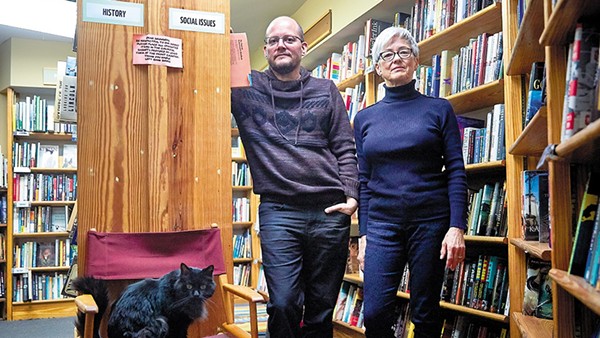
Kris Kleindienst and her team at Left Bank Books knew they were going to have to do something about ongoing book bans in school districts around the state after the Wentzville School District banned Toni Morrison’s . Before they could even formulate a plan, customers were calling and donating money, asking what Left Bank was going to do.
Kleindienst tells the the support was overwhelming for a project that hadn’t even started yet, but would soon become The Literacy and Justice Project. In a little less than a month after its inception in January, the project has raised over $10,000 to fight book bans across the state. The project donates books that land on a banned list – such as and , a graphic novel about the Holocaust that was banned in a Tennessee school district in early January – to those that request them through a link on Left Bank Books’ website, a super simple way to get the books in hands of readers, the store owner says.
For the community to step up for young readers in this way, it means everything to Kleindienst.
“It makes me really proud of our community for one thing,” Kleindienst says. “The vast majority of people don’t support the banning of books or the oppression of the right to read. And it’s worth noting – and I do note it when given the opportunity – the books they’ve selected, whatever sort of semi-bogus reason they’re giving, the actuality is that they’ve selected books by Black and LGBTQ+ writers, and Jewish in the case of . That’s not an accident, that’s intentional. It’s racist, homophobic strategy to really eliminate access to certain kinds of information, to indoctrinate young people in one really narrow, homophobic view. It’s antithetical to education, antithetical to democracy, to human rights. So, because of that, the fact that folks have been so generous gives me hope about the kind of community we really live in.”
Speaking as a queer woman, Kleindienst emphasizes that we can’t take the community we live in for granted, since queer people and those of color have been the target of “this sort of thing forever.” Students and other young readers deserve to open a book and see themselves in it, Kleindienst says, but it shouldn’t just be for people of color and queer folks. White people and straight people have a responsibility to read the stories of marginalized voices, Kleindienst says.
And it doesn’t stop there.
“Adults in the community have to speak out when students’ rights to read are abridged like this,” she adds.
Other than speaking out, which the bookstore owner advocates for adults and students both to do, she stresses the importance of voting in local elections. Kleindienst also encourages students to organize in their schools, and not let anyone tell them what they can’t read.
Currently, the store has received over 100 requests for the books. The novels that have fallen victim to a ban have had to immediately be reprinted at their publishers, an irony that the store owner points out: The quickest way to land a book on the bestseller list is to ban it.
The way Left Bank’s nonprofit arm operates allows the bookstore to be flexible in its response to the moment, so while the way they’re getting these books to those who want them is a direct link now, Kleindienst says they’re also reaching out to schools and districts to see if any libraries need the stories.
Wentzville School District recently reversed their ban on after the backlash. But, others that were banned alongside Morrison’s novel still remain removed from shelves. And for that reason, Kleindienst says Left Bank will keep fighting.
As long as they have books to give away, as long as someone wants to donate money for the cause, Kleindienst says the Literacy and Justice Project will continue on.